In short
If your categories feel inconsistent, bloated, or full of “Other,” you’re seeing taxonomy drift. This article explains why category structures break as you scale, why it blocks PIM and AI, and how to shift to deliberate evolution: clear principles, governance, audits, and faceted navigation
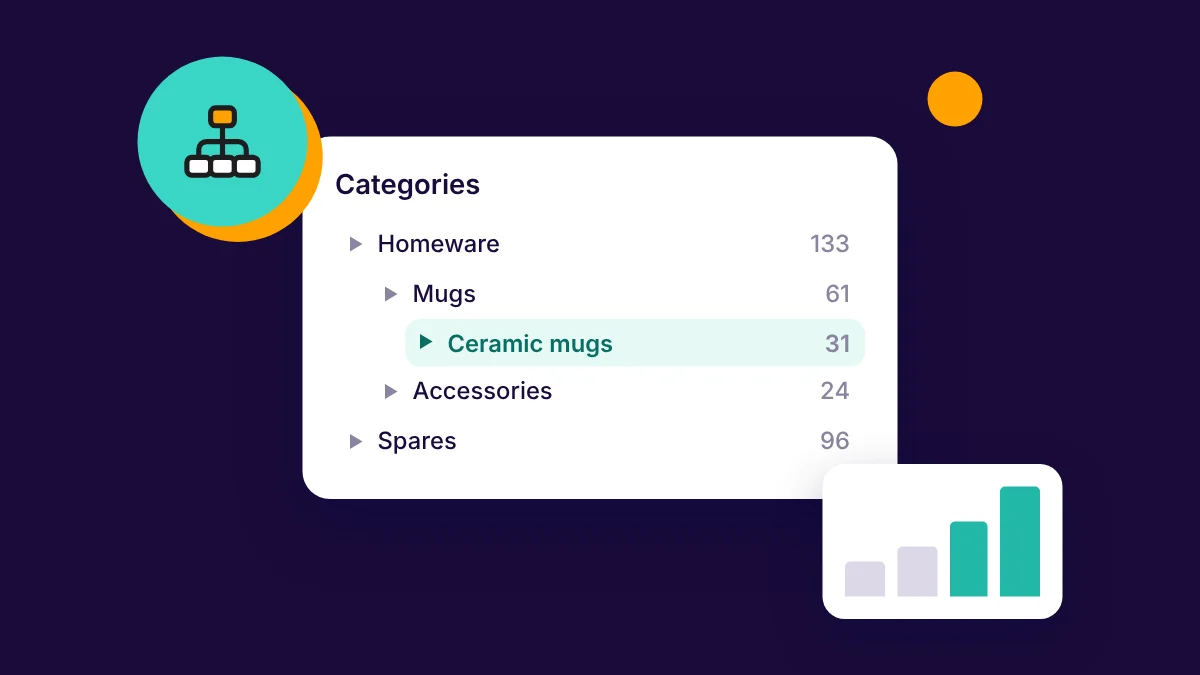
Most merchants don’t set out with the aim of complicating life by building a confusing category tree. It just... happens, slowly at first, and then all with gathering speed. One day, a structure that worked perfectly well for 1,000 products becomes a maze with no exit at 50,000. Internal teams are in constant disagreement about where SKUs belong. Suppliers classify inconsistently. And the customers? For them, finding what they want in “three clicks or less.” Is maddeningly out of reach. Every “quick fix” you apply makes the next fix even harder.
This issue is rarely a strategy problem. It’s more a structural one caused by organic growth without adequate governance. Over time, your taxonomy drifts away from how customers shop, how products relate to each other, and what your operational systems (PIM, ERP, search, and now AI) need in order to work reliably. Our article digs deeper into why this happens and what practical steps you can take to address this structural deficit.
A category tree is meant to do two jobs simultaneously:
When the tree drifts, it fails you in both ways. At first, symptoms are small:
If your teams need to spend more time debating placement than actually listing products, the structure, as opposed to supporting work, is creating a greater volume of it.
Taxonomy drift is the predictable outcome of four forces acting together.
Internal org charts seep into navigation: departments, supplier demands, or campaign needs become permanent branches. But remember, customers don’t shop using your internal constraints as their criteria. They shop by recognition, intent, and comparison.
A new range arrives that “doesn’t quite fit,” anywhere, so a new bucket is created. Your latest seasonal collection requires prominent placement, so it becomes a top-level category and then somehow never gets retired. One of your key suppliers wants a ‘shop-in-shop,’ so you dutifully graft on another branch. You could argue that, in isolation, each of these decisions is rational. However, aggregate them and they have a corrosive effect on your performance.
Over-categorisation creates a paradoxical ‘agony of indecision.’ Splitting “summer dresses” from “sundresses” might feel highly precise, but it simply forces shoppers into narrow corridors. It also increases the chance they choose the “wrong” corridor and reach the assumption that you don’t stock what they want.
This is where, ironically, so many category trees inadvertently become more restrictive. You haven’t enhanced navigation - you’ve made it more difficult.
Think of fast-moving categories like AI, smart home, health, or sustainability). Potential purchasers are increasingly thinking in terms of outcomes and use cases, not simply product definitions. For instance, “AI-powered CRM” is a feature label; “Sales Automation” is an outcome label. If your taxonomy describes what something is rather than what it does, you’re missing customer intent, and your categories will stop mapping cleanly to how people actually search.
Once categories start to drift, the damage isn’t confined to navigation.
So, a broken category tree isn’t just an operational (and revenue-slashing) pain in the neck. It makes every downstream system fundamentally less reliable.
Many businesses use subcategories to encode attributes like size, material, colour, season, brand, or compatibility, - but that’s how they end up struggling with deep menus and thin category pages.
A more fit-for-purpose pattern in most catalogues is:
This approach considerably reduces the risk of menu sprawl as well as improving discovery and making schema design easier. This is because attribute logic is located where it should be - in structured data, rather than in naming conventions.
A scalable taxonomy isn’t ever truly “finished.” It’s governed. And good governance acts when circumstances change. A mindful approach to your taxonomy evolution needs:
Let’s say you were to hire a new merchandiser tomorrow. Would they be able to classify consistently without having to resort to internal ‘tribal knowledge’? Or, if a supplier joined next week, could they map products without endless messages back-and-forth? Finally, If a customer arrived via organic search, would your category page actively help them to compare, as opposed to landing and wondering where to go next?
If the answer to any of these is “mmm...not really,” the last thing your categories need is yet more exceptions. What they need is a controlled plan for evolution.
If your categories feel bloated, duplicated, or full of “Misc/Other,” it’s high time to stop the drift. Get in touch with us today at Start with Data and we’ll discuss how we can conduct a Product Data Structure Audit for your outfit so you can get a clear map of what’s broken, why it’s happening, and what to fix first.

Fill in your details and we will send it straight over.
Category structures and attribute models designed around how your customers search and buy.

Talk to us about your taxonomy and attribute model.
