In short
AI doesn’t need more product data. It needs the right layers of data. This guide reframes Kotler’s model into five practical data layers and shows how modern PIM, governance and onboarding make each one production-ready across the digital shelf.
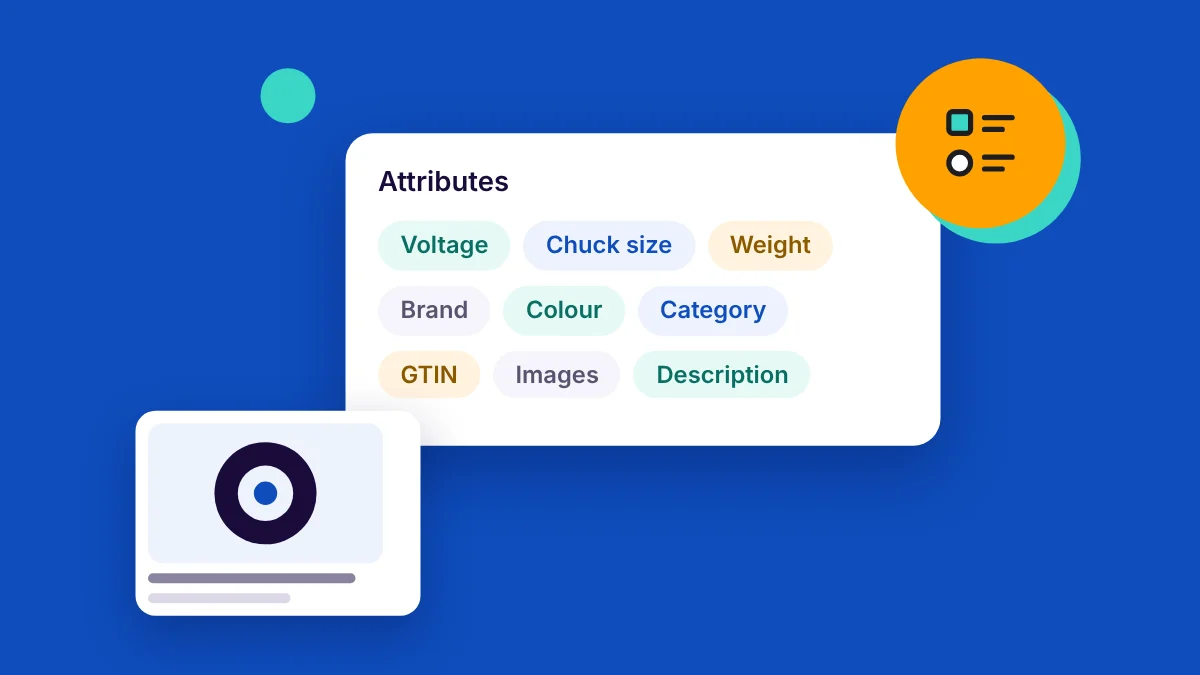
Customers don’t buy objects; they buy outcomes, and the way we express it has changed over time. Nowadays, these outcomes are encoded as data which extends across ERPs, supplier feeds, DAMs and marketplaces. If you want AI tools to perform optimally – that is, performing retrieval, augmented generation, semantic search, or automated enrichment, your product data needs to be arranged in five clear layers, not in one big messy pile.
Our article provides you with a practical blueprint, underpinned by Kotler’s[1] five product levels and updated for the field of Product Information Management (PIM) in an era defined by the power of AI to add value to that management.
This is the “why” behind the SKU: the job to be done, primary use cases, and the customer context in which they select that product. For instance, “portable power for site tools” rather than “18V battery”. If you capture this layer well, it narrows the search space, and reduces the chances of AI hallucination[2].
What ‘good’ looks like
This is the foundation upon which the product becomes unambiguous and computable: identifiers, mandatory specs and fixed or controlled set of measurement units for consistency, accuracy, and safe interpretation of attributes (‘unit-secure’). If this layer is unstable, every downstream AI task loses that stability too.
These are the attributes, assurances and conditions which customers consider as deal makers or breakers: performance ranges, compatibility, safety and compliance, warranty and service information, and localised content, This is also where channel requirements live.
This is the rich context that differentiates your offer:
It’s the difference between a humdrum product spec sheet copy-pasted from a supplier sheet, and a truly compelling product story.
Use AI to tag assets, cluster reviews, and generate benefit-led copy which is tailored to the right audience on the right channel. Feed the knowledge graph to your RAG pipeline so generated descriptions cite the right facts, not guesswork.
The more your AI learns, the better and more useful it’s going to be in terms of:
Start with the tasks you want AI to support (think findability, compatibility, configuration, selection, service) and derive fields and relationships that answer those questions.
Give suppliers guided templates with validation as a gatekeeper. Auto-map attributes and route any exceptions to the appropriate team. Remedying issues at source reduces rework and accelerates time-to-market.
PIM is your governed product truth, to which you can add modular services for areas like classification, translation, media, analytics or syndication. Your clean and trustworthy product data can be safely used with downstream AI using APIs.
We need to move past generic “completeness” by tracking metrics like:
Using the 5-layer model as a framework, implement quick-check quality criteria:
And
A bit ‘techie’, that last one: Essentially, it means that your product data isn’t just a pile of text. It’s arranged as connected facts, with labels that make it easy for an AI tool to fetch exactly what it needs and cite it. You’re capturing the who/what/where/why/how around a product: variants, compatible parts, standards, materials, safety notes, images, region rules, lifecycle status, customer segments, use cases, and so on. Think: the story around the SKU, not only the SKU.
The acronym RAG means Retrieval-Augmented Generation. When you tag and chunk content an LLM can retrieve first and generate second. In practical terms, you need to:
If you want AI to work with your product data, not guess at it, let’s talk.
We’ll help you assess which layers are missing, where risk is creeping in, and what to fix first to get real commercial value from AI. If you’re ready to turn your product data into a durable advantage, get in touch with us today
A product knowledge graph is a map of everything your products ‘know’ about themselves, and how those facts connect. So, instead of using flat data tables, you model products as nodes (things) with relationships (how those things link) and properties (the facts). It makes the difference between a bog-standard parts list and a living wiring diagram.
As a result, customer queries like “Which drills sold in Germany are gypsum-safe and compatible with anchor X?” become a stroll in the park, not a search for needles in a spreadsheet haystack.
[1] Philip Kotler was a highly-renowned author, educator, and consultant, widely regarded as the "father of modern marketing".
[2] Real instances where the AI model generates product information that is factually incorrect, nonsensical, or entirely fabricated, yet presented with a tone of confidence and authority. If the data used to train the AI contains inaccuracies or is not representative of all products, the model simply learns and perpetuates these errors

Fill in your details and we will send it straight over.
What your product data needs so AI search and shopping assistants can find and describe your products.

Talk to us about what AI-ready product data means for your catalogue.
