In short
Most PIM ROI business cases collapse after go-live because they price features, not operational change. Real value comes from removing manual handoffs, reducing rework, accelerating time-to-market, and cutting preventable returns. Here’s where the return actually shows up.
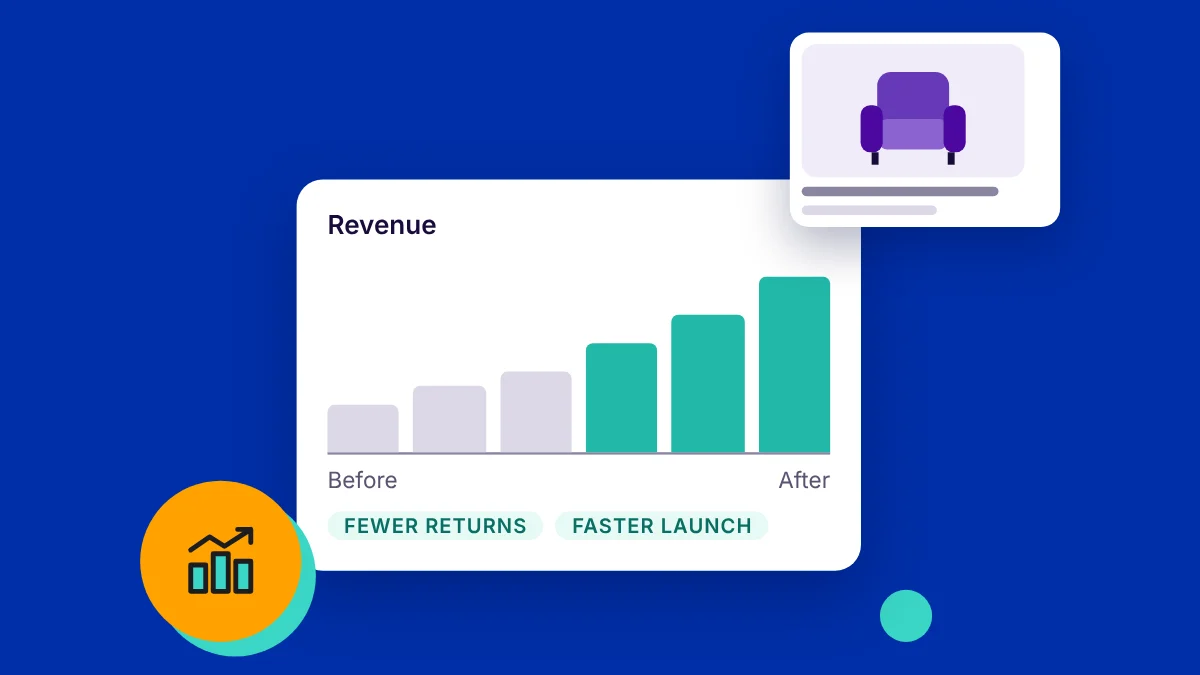
When a merchant dedicates considerable time, money, and effort to choosing, buying, and implementing a Product Information Management (PIM) system, the narrative regarding its ROI is usually delivered in a confident and clean way. The vendor calculator produces a big number. The platform goes live. But then, in many cases, 18–24 months down the line and the question becomes awkward: “What did we actually get back?”
The underlying issue isn’t usually that the PIM “failed” as such. It’s a question of the business case. Many are built around capabilities and features, while the real return will only appear if and when a merchant changes how operations are done.
ROI models used by vendors tend to treat PIM like a bundle of features:
Of course, they’re all genuine capabilities. The big ‘BUT’ is that they aren’t actual outcomes. Yes, a good PIM can support 40 channels, but don’t expect organisational miracles - it can’t create channel performance. A PIM can store structured attributes; it doesn’t automatically guarantee supplier data is complete. True value only materialises when the business turns these capabilities into repeatable behaviour. And that’s why, two years on, teams can easily describe what was implemented, but they’ll struggle to point to measurable returns. They tracked the rate of user adoption (“we switched it on”) but failed to pay attention to operational changes (“we stopped doing X, so Y moved faster, and with fewer errors”).
The most reliable way of determining the ROI on your PIM is to identify operational waste which disappears (or is minimised) once product data becomes a governed, trusted working system as opposed to a mere system of record.
Look for those routinised (or frequent) tasks and incidents which occur everywhere and for which accountability doesn’t stop at anyone’s door:
These add up to being the hidden cost base of chaotic product data management. So, to hammer home the point, a PIM solution doesn’t create ROI simply by being present; it creates ROI when it makes that wasted time, effort, and money unnecessary.
Those businesses which are able to articulate sustained ROI usually see that value concentrated in a relatively small number of operational levers. Moreover, most of these levers aren’t “digital transformation” narratives; they are simply the economics of throughput.
1) Faster time-to-market is a ‘selling-days dividend’
The clearest quantitative gain is the reduction in time to market when that reduction is an operational reality. If you reduce launch time by 50% for a set of products, you’ve not only saved effort - you’ve increased selling days.
Often enough, you can apply a simple model:
Additional selling days × expected daily unit volume × margin per unit
Even a cautious and conservative assumption will make the return visible, especially in seasonal categories where ‘late to market’ effectively means ‘missed market opportunity.’
2) Rework elimination is the biggest recurring saving
In many organisations, teams underestimate how much time they are forced to spend correcting errors created upstream – the typical culprits?
The value of a PIM emerges when the business no longer pays for the same work multiple times.
The ROI here isn’t very ‘glamorous,’ but it is enduring and significant for your bottom line:
3) Returns rate and service overhead fall when products launch cleanly
Businesses often discuss returns as a customer-experience problem. It is, but the underlying financial mechanism is operational: Inaccurate content creates expectation gaps, which in turn create returns, which create a higher service load and, as an outcome, erode margin. When the ‘digital twin’ is always accurate and consistent, the number of preventable returns goes down. Thus, you make savings not only in reverse logistics, but in the operational burden downstream (which hardly ever gets attributed to the actual product data).
4) Channel expansion becomes marginal, not exponential
Without a working single source of truth, each new channel multiplies workload: new templates, new rules, new exceptions, new reconciliation. With governed product data, adding a channel becomes closer to configuration than a project—but only if the content standards and ownership already exist. Syndication tooling helps. The bottleneck is usually caused by channel-specific requirements and a lack of ‘completeness discipline,’ not the connectivity between business and channel.
5) The cost of content production drops if data ownership is explicitMultilingual content, compliance fields, technical attributes, imagery aren’t going to maintain themselves. ROI on a PIM improves when accountability is so transparent that completeness only needs to be achieved once but can then be reused everywhere, rather than rebuilt per channel, per campaign, per region.
A robust ROI narrative clearly separates (and credibly addresses) two questions:
If you’re unable to answer the first, the second is basically wishful thinking. Vendors can calculate the estimatedpotential; what they can’t do is substitute that potential for operational commitments.
When a PIM system’s ROI is nebulous or at minimum, debatable, there’s normally one underlying mismatch:
The organisation measured software adoption, but the value requires operational ownership and governed throughput.
Furthermore, forced user adoption is unsuccessful because the PIM is being treated as a feature purchase, while the genuine returns can only be produced by an operating model.
If you’re getting the impression that return on investment for your new PIM is ‘overstated,’ disputable, or that evidence is hard to unearth, get in touch with us today at Start with Data and let’s arrange a Discovery Call. It’ll focus on your operational reality:
activated features)
All you need to do is bring your current process and a representative example of a recent launch. We can then map where the value is actually leaking and how to do a good repair job so that your ROI is actually visible, measurable, and something to celebrate.

Fill in your details and we will send it straight over.
Independent help to shortlist, compare and choose the right PIM for your catalogue and team.

Talk to us about your shortlist and what each platform will really take to run.