In short
Teams keep “fixing” product data but mix up cleaning and enrichment. This guide shows what each one does, why enrichment fails on dirty data, and the operating model - definitions, validation rules, workflows and ownership—that makes improvements stick.
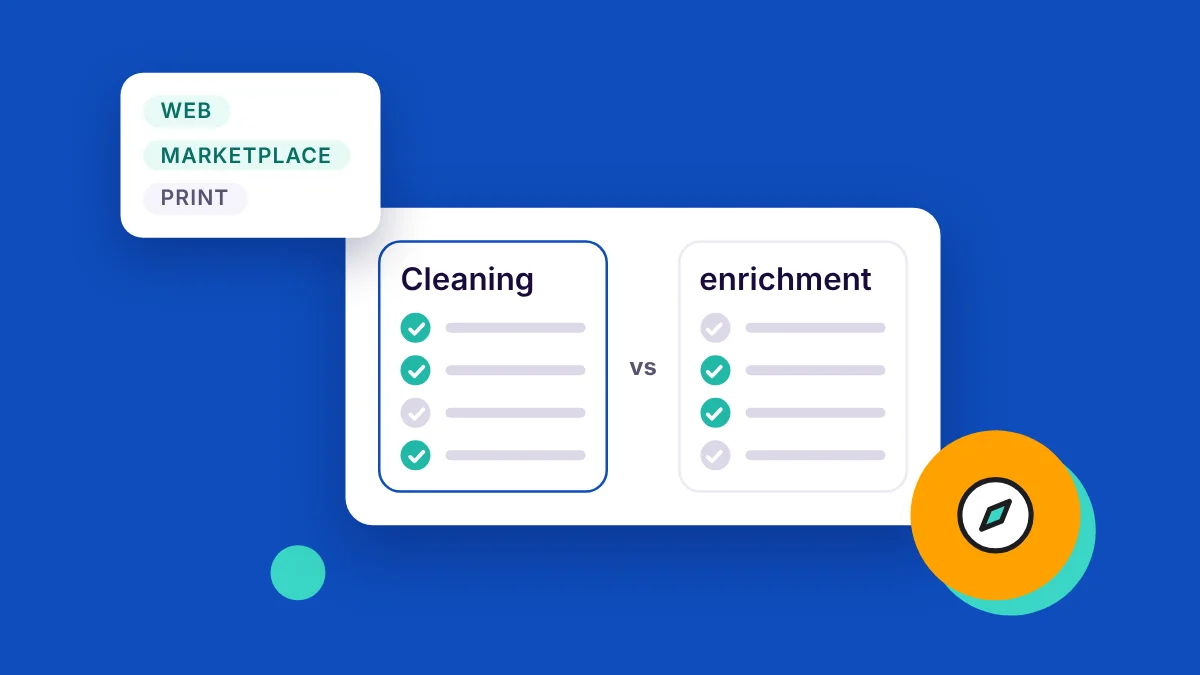
Normally, it’s not a question of poor-quality product information failing because you didn’t add enough content. Most frequently, it doesn’t pass the sniff test because your teams have confused data cleansing with data enrichment – they’ve applied the wrong fix at the wrong time.
This article outlines the difference, the failure modes behind this confusion, and what actually fixes product data in a business running on legacy ERP/PIM/feeds. We’ll leave you in a position to diagnose whether you need cleaning, enrichment, or both, as well as revealing how you can stop the same issues reappearing regularly.
Data failure: cleaning and enrichment are treated as interchangeable tasks in backlogs, supplier onboarding, and ‘content projects.’
‘
Operational consequence: duplicated effort, constant rework, and a range of conflicting updates across ERP, spreadsheets, supplier feeds, and eCommerce.
Commercial (and risk) impact: channel rejections, slower time-to-market, poorer discoverability, and preventable increase in returns.
This has predictable causes in mature organisations:
Carried out suitably, cleaning enhances the reliability of what data you already have. At base, it’s about the triple whammy of correctness, consistency, and structural integrity.
The typical features and actions around cleaning your data? A lot of rules for a start!
And for your incoming supplier feeds:
Cleaning fixes the following operational paint points which, left to their own devices, become so brittle they eventually snap:
We’ll add ‘Internal mistrust in reporting’ as a fifth factor. With such a mess, who would rely on it? A product record is not commercially usable if key attributes are missing, descriptions are skeletal, or assets simply aren’t present.
Enrichment enhances the usability of product data for purchasing decisions and compliance with channel requirements. It adds what’s missing and makes your product records fit-for-purpose in terms of discovery, comparison, and compliance.
Typical enrichment artefacts and actions include:
Enrichment drives outcomes like higher channel acceptance, better on-site filtering, improved SEO, fewer ‘what are the correct specs?’ enquiries, and reduced returns caused by missing or unclear information.
If you enrich data before you clean it, you’re simply scaling up the errors:
If your teams keep generating ‘enhanced content’ but marketplaces are still rejecting listings, and customers are still complaining that specs are wrong, you’re not only failing at enrichment. You’re failing at cleaning and rule enforcement.
A good diagnostic exercise is to use these three tests in one category (not your full catalogue!):
1. Accuracy test (cleaning)
Take 50 high-selling SKUs and verify 10 critical attributes against manufacturer documentation. If you find conflicting units, impossible values, or variants mis-assembled, prioritise cleaning.
2. Completeness test (enrichment)
Take the same SKUs and compare your attribute coverage to what your best channel requires (filters, compliance fields, key specs). If you’re missing the fields which buyers use to decide, prioritise enrichment.
3. Regression test (governance)
Check the last three supplier feed cycles. If ‘fixed’ data reverts, your issue isn’t a lack of effort! Rather, it’s the process: No ownership, a faulty overwrite logic, and missing approval gates.
Cleaning and enrichment work only when you treat them as steps embedded in an operating model rather than as ad-hoc projects.
1) Stabilise (stop the bleeding)
The outcomes are: fewer failures in feeds to channels, fewer listings with duplicates, and a much-reduced need for manual firefighting.
2) Standardise (make ‘good’ a repeatable threshold)
The outcome? Faster onboarding, consistent filtering, and fewer arguments about what ‘the right value’’ actually is.
3) Enforce (preventing regression to a bad norm)
The outcome is: Fewer rework cycles, higher channel acceptance, and a measurable improvement in time-to-market.
Cleaning fixes errors. Enrichment makes data usable. The big ‘BUT’ is that neither of the two fixes product data on its own, because the underlying and recurring issue is data governance:
Those businesses which gain best traction in their product data management are those which treat cleaning as the foundation, enrichment as the value-add, and the operating model as the permanent fix.
Reach out to us today at Start with Data. If you want to see what ‘cleaned then enriched’ looks like in practice (as in: attribute dictionary extract, validation rules, supplier template, and a channel-ready product record), we’ll be more than happy to collaborate with you to create a sample output.

Fill in your details and we will send it straight over.
Independent help to shortlist, compare and choose the right PIM for your catalogue and team.

Talk to us about your shortlist and what each platform will really take to run.